Kalyani Collections
Our Craft: Block-Print and Bandhani
How Jetpur block-print and bandhani are made — and why the process matters to boutique buyers.
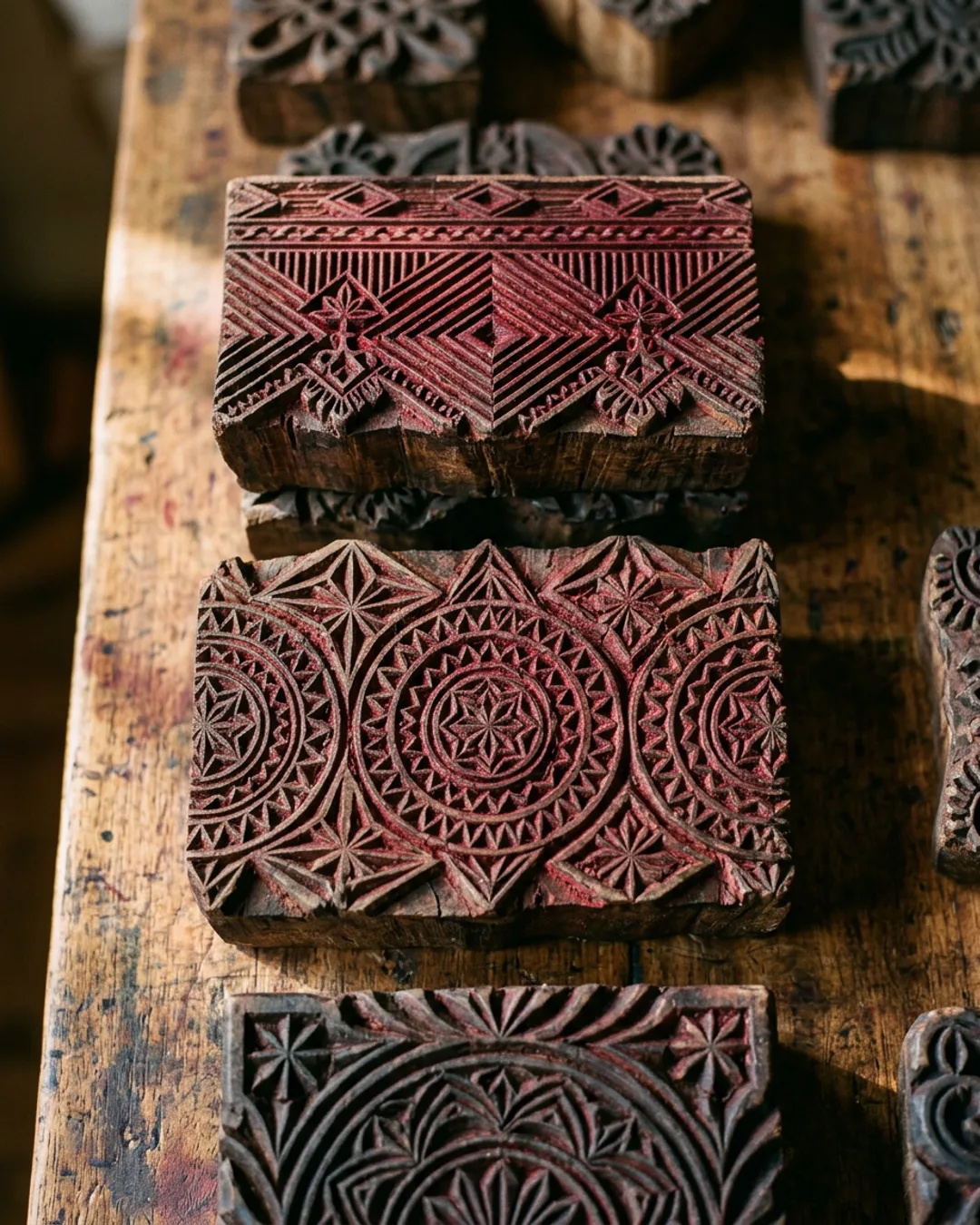
Hand block-printing at our Jetpur workshop
Our Craft: Block-Print and Bandhani
Jetpur, Gujarat is known for one thing: printed textiles. The cluster has built its reputation over decades on cotton block-printing, screen-printing, and bandhani tie-work that supplies boutiques, exporters, and retail chains across India.
Block-Printing
Block-printing starts with a carved wooden block — each design is specific to a print run. We press the block into a dye tray, then onto the fabric by hand, repeating across the length of the saree. Small variations in pressure and alignment are not defects. They're the signature of a hand-pressed block, not a machine cylinder.
How to spot genuine block-print:
- Slight dye bleeding at the edge of motifs
- Minor spacing variations between repeats
- The faint impression of the block's wood grain in the dye
Every Kalyani batch ships with a card naming the block design, the dye lot, and the printing date. Your customers can match the card to the saree.
Bandej and Bandhani
Bandhani is a tie-and-dye tradition. Individual threads are tied at precise points across the fabric before it goes into a dye bath. When the ties are removed, the undyed dots form the pattern.
The GI tag on Rajasthan and Gujarat bandhani means origin is documentable. We produce our bandej dupattas in Jetpur using this method. Genuine hand-tied bandhani has irregular dot spacing — the tying is done by hand, so no two rows are perfectly uniform. That irregularity is proof.
Machine-printed bandhani mimics exist in the market at lower price points. The dots are uniform, perfectly spaced, and printed rather than tied. We document our process so you can show your customers the difference.
GSM and Fabric Weight
We specify GSM (grams per square metre) on every product. This matters because fabric weight determines how a saree drapes and how transparent it is. Our cotton sarees run 90-120 GSM — opaque, drape-ready, pre-washed for colour-fastness.
If a supplier doesn't tell you the GSM, ask. It's the single most useful spec for avoiding the photo-vs-reality mismatch that earns refund requests.